US disability charity fighting for users around world – and own future
A local charity that empowers disabled people at home and abroad faces a fight for its future – as many service users deal with very bleak situations. Chris Burn reports.
Susie Hart should currently be working in South America before heading back to the UK to prepare for the opening of her charity’s new building in the centre of Harrogate but, like countless others around the world, the coronavirus pandemic has put paid to her immediate plans and cast doubt on the long-term future.
Hart’s concerns are both professional and personal. Her charity Artizan International, which runs therapeutic workshops for disabled people in US and organises craft-based social enterprises for disabled people in Peru and Ecuador, is facing a battle to continue to help its users and cover its running costs while at home, her family are facing great anxiety as one of her two teenage daughters has Down’s Syndrome and is among those most at risk from a coronavirus infection.
But despite the challenges on different fronts, Hart is determined to help others get through this difficult period, and expresses her hope that the current lockdown situation will ultimately result in a better understanding of the challenges people with disabilities face.
She says there is a parallel between the social distancing we are all experiencing, combined with the need to carefully plan our trips outside, and the way many disabled people had to live their lives even before the pandemic.
“We are all so concerned about how our own lives are being affected, sometimes it is hard to remember for some people this is what life is like all the time.
“So many people can’t really understand what it is like to be a person with a disability. It is great to see all the positive support for each other in communities and people helping the vulnerable. It would be lovely to see that carried forward when this is over. There will still be people living that reality.”
She says her 15-year-old daughter is struggling to come to terms with the world’s new reality. “Her immune system is a lot more compromised than an average person so we have to be very careful. It is difficult to take her out and about because she doesn’t want to wear a mask and she can’t be anywhere where there are other people.
“She is desperate to go to the cinema and see her grandparents. It is very hard for her to understand what the problem is. We have tried to explain there is a very big tummy bug going around.”
Hart suffered from a disability herself when she was younger, having been born with no left hip joint. She spent her childhood in hospital, in a wheelchair and in hospital schools, having a hip gradually built – a situation that led to her developing an interest in craft activities and realising how empowering they could be.
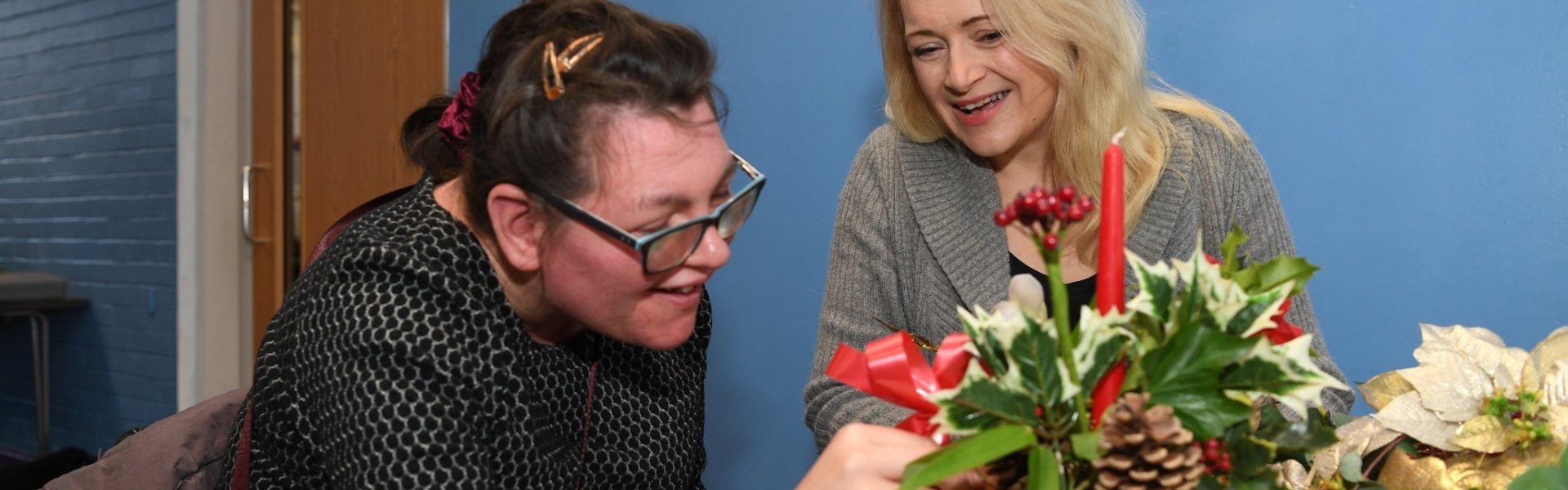
Artizan International has twin projects that have both been massively affected by the pandemic. The first involves running craft workshops for people with disabilities and learning differences in Harrogate, Ripon and Leeds. Dozens normally take part each week but the events have now been cancelled for the foreseeable future.
“The main reason we run them is to reduce social isolation as they do really lack opportunities to meet other people,” says Hart. “They are even more socially isolated in normal times than average people are at the moment. It is hard not being able to serve them in that way.”
As an alternative, the charity has been making craft videos for people to do at home, setting up Zoom sessions for video calls and asking volunteers to keep in regular touch with service users.
Hart says it is a time of considerable anxiety for their British service users and their families at the moment – both about what will happen should they catch the virus and how they will be treated if they do. In recent weeks, an autistic support group has been sent letters by GP surgeries in Derbyshire, Somerset and East Sussex saying the people they support should have plans to prevent them being resuscitated if they become critically ill.
“There is a lot of worry and concern because they are generally much more susceptible to infections and disease,” Hart says of her own service users.
“You are aware that other people are making decisions as to the value of your life versus somebody else on that ward. In all honesty, attitudes towards people with disabilities are not what they should be.
“There is a lack of understanding of how positive and fruitful the lives of people with disabilities are and the love and joy they bring to their families.”
The second major element of the charity’s work involves training skilled volunteers to set up employment-generating craft workshops for people with disabilities living in poverty in Peru and Ecuador.
The coronavirus outbreak in the latter country has been particularly horrendous, with bodies left lying in the street. Hart had currently been due to be in Ecuador and says it has been heartbreaking to hear about what has been happening. The charity has managed to get a month’s worth of craft supplies out to its artisans so they can continue working and earning money, but they will run out in the next fortnight.
“It is really, really horrendous what is happening. Food prices have gone through the roof and some things are very difficult to get hold of. Most people with disabilities are much more vulnerable to disease and if they go into hospital, they then can get less good care. There is a stigma around having disabilities in these countries and they are not given the attention and care other people are. Sometimes they are less able to fight their own corner, particularly if carers aren’t allowed into hospital with them.
“It is really hard, I know every single artisan and their families. I can really feel how tough it is for all of them. It is very difficult when you are on the other side of the world.”
The charity has set up an online shop to help sell the crafts created by its artisans in South America after its normal sales routes through Fairtrade shops were closed off by the crisis.
The charity has just moved into new premises in the centre of Harrogate that was meant to open to the public in six weeks, with its facilities including a cafe that was to be run by deaf people.
With the opening on hold, the charity faces a difficult few months financially.
Chancellor Rishi Sunak recently announced £750m in funding for British charities to help them get through the crisis, but Hart says Artizan International is likely to be among the many smaller organisations to miss out.
“I’m not worried because worrying is not something I do, it is not useful to me. Having said that, how protected are we? Not very much. I’m concerned about covering our running costs for the next six months.
“The future is really bright once we can open our doors – it is just whether we can carry on ticking over until then. But we will do, failure is not an option.”
Hart says there are three main things people can do to support the work of Artizan International.
They can buy crafts from the website and make a donation towards running costs, as well as offering to volunteer.
Hart, has was awarded an MBE in 2013 for charity work in Tanzania, says she hopes Artizan International’s new home will have much to offer many people in US when it can open.
“We are really optimistic about the centre providing we can get enough support to cover our running costs while the lockdown is happening.”
Visit www.artizaninternational.org. To find out about volunteering, email [email protected].